Skip to contents

1 Introduction

Traditional variable selection methods (e.g., backward elimination, LASSO) optimise statistical performance metrics such as AUC or deviance. However, the best-performing model in statistical terms does not necessarily yield the best clinical utility when predictor costs (test harms) are accounted for. The NBvarsel package implements a variable selection framework based on cross-validated Net Benefit, the standard metric for clinical utility in decision curve analysis.

The core function nb_varsel() evaluates predictor subsets by their contribution to clinical decision-making, optionally adjusted for test harms. It supports:

  • Exhaustive and groupwise (backward elimination) search strategies
  • Predictor costs (per-variable or grouped)
  • Restricted cubic splines for continuous predictors
  • Interaction terms
  • Permutation importance scores
  • Parallel computation

2 Simple illustration

Reproducible section

This section is fully reproducible as the data generation is included in the code.

Let us consider a hypothetical scenario with four predictors, two continuous (X1X_1, X3X_3) and two binary (X2X_2, X4X_4), used to predict a binary outcome YY. The true data-generating model is:

logit(Y)=3+3X1+2X2+0.1X30.05X4(1)\text{logit}(Y) = -3 + 3X_1 + 2X_2 + 0.1X_3 - 0.05X_4 \qquad(1)

In this model, X1X_1 and X2X_2 are strongly predictive, X3X_3 and X4X_4 are weakly predictive, and the outcome has a prevalence of approximately 64%. Each predictor is associated with a test harm: X1X_1 and X3X_3 (harm = 0.05), X2X_2 (harm = 0.025), and X4X_4 (harm = 0.00005).

2.1 Data generation

Code
set.seed(42)
n <- 1000

X1 <- rnorm(n, mean = 0, sd = 1)
X2 <- rbinom(n, size = 1, prob = 0.7)
X3 <- rnorm(n, mean = 0, sd = 1)
X4 <- rbinom(n, size = 1, prob = 0.5)

log_odds <- -3 + 3 * X1 + 2 * X2 + 0.1 * X3 - 0.05 * X4
prob <- plogis(log_odds)
Y <- rbinom(n, size = 1, prob = prob)

df <- data.frame(X1 = X1, X2 = X2, X3 = X3, X4 = X4, Y = Y)

harms <- c(X1 = 0.05, X2 = 0.025, X3 = 0.05, X4 = 0.00005)

2.2 Backward elimination (baseline)

Using backward elimination based on Wald’s statistic, as implemented in fastbw() of the rms package:

Code
model_full <- lrm(Y ~ X1 + X2 + X3 + X4, data = df)
bw_result <- fastbw(model_full)
sprintf("Backward elimination retains: %s", paste(bw_result$names.kept, collapse = ", "))
[1] "Backward elimination retains: X1, X2"

2.3 Exhaustive net benefit variable selection

Code
exhaustive <- nb_varsel(
  data = df,
  outcome_var = "Y",
  include_interactions = FALSE,
  costs = harms,
  cv_folds = 5,
  mode = "exhaustive",
  thresholds = 0.5,
  allow_parallel = FALSE,
  permutation = TRUE,
  splines = FALSE,
  n_knots = 3,
  verbose = FALSE
)

2.4 Results

Code
tbl_train <- exhaustive$all_models

tbl_train |>
  select(Model, AUC, Brier, Total_Cost, Avg_Adj_Net_Benefit, Avg_Net_Benefit) |>
  arrange(-Avg_Adj_Net_Benefit) |>
  gt(id = "tb-train") |>
  fmt_number(
    columns = c("AUC", "Brier", "Avg_Adj_Net_Benefit", "Avg_Net_Benefit"),
    decimals = 3
  ) |>
  cols_label(
    Model = "Included predictors",
    AUC = "AUC",
    Brier = "Brier Score",
    Avg_Net_Benefit = "Avg. Net Benefit",
    Total_Cost = "Total Cost",
    Avg_Adj_Net_Benefit = "Avg. Adj. Net Benefit"
  )
Table 1: Results for the simple illustration. Models are ranked by cost-adjusted Net Benefit.
Included predictors AUC Brier Score Total Cost Avg. Adj. Net Benefit Avg. Net Benefit
X1, X4 0.906 0.115 0.05005 0.104 0.154
X1 0.907 0.114 0.05000 0.102 0.152
X1, X2 0.925 0.102 0.07500 0.099 0.174
X1, X2, X4 0.925 0.102 0.07505 0.099 0.174
X1, X3 0.906 0.114 0.10000 0.056 0.156
X1, X3, X4 0.906 0.114 0.10005 0.055 0.155
X1, X2, X3, X4 0.925 0.102 0.12505 0.049 0.174
X1, X2, X3 0.925 0.101 0.12500 0.048 0.173
X4 0.521 0.217 0.00005 0.000 0.000
X2 0.589 0.210 0.02500 −0.025 0.000
X2, X4 0.571 0.211 0.02505 −0.025 0.000
X3 0.532 0.217 0.05000 −0.050 0.000
X3, X4 0.520 0.217 0.05005 −0.050 0.000
X2, X3 0.607 0.210 0.07500 −0.075 0.000
X2, X3, X4 0.593 0.211 0.07505 −0.075 0.000

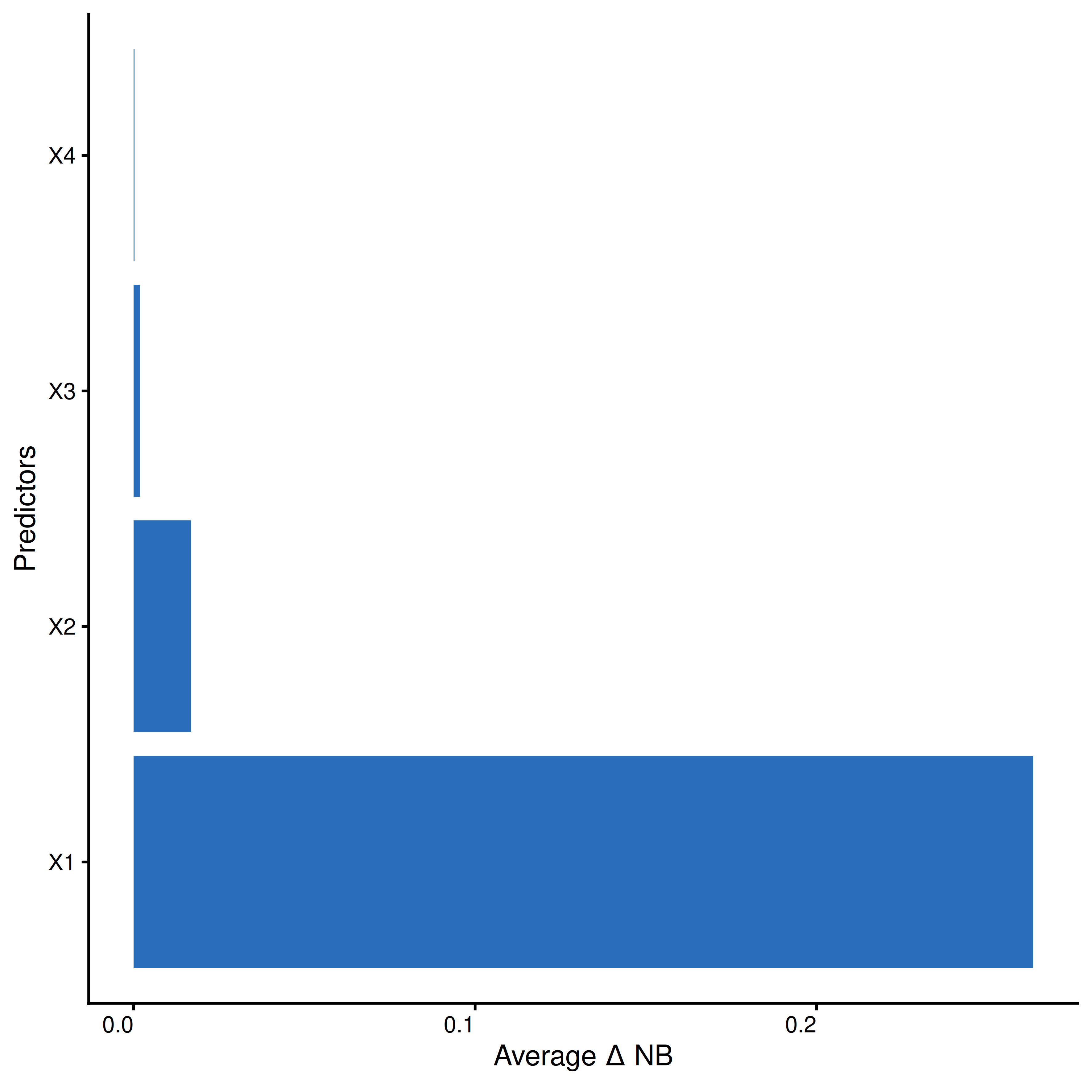
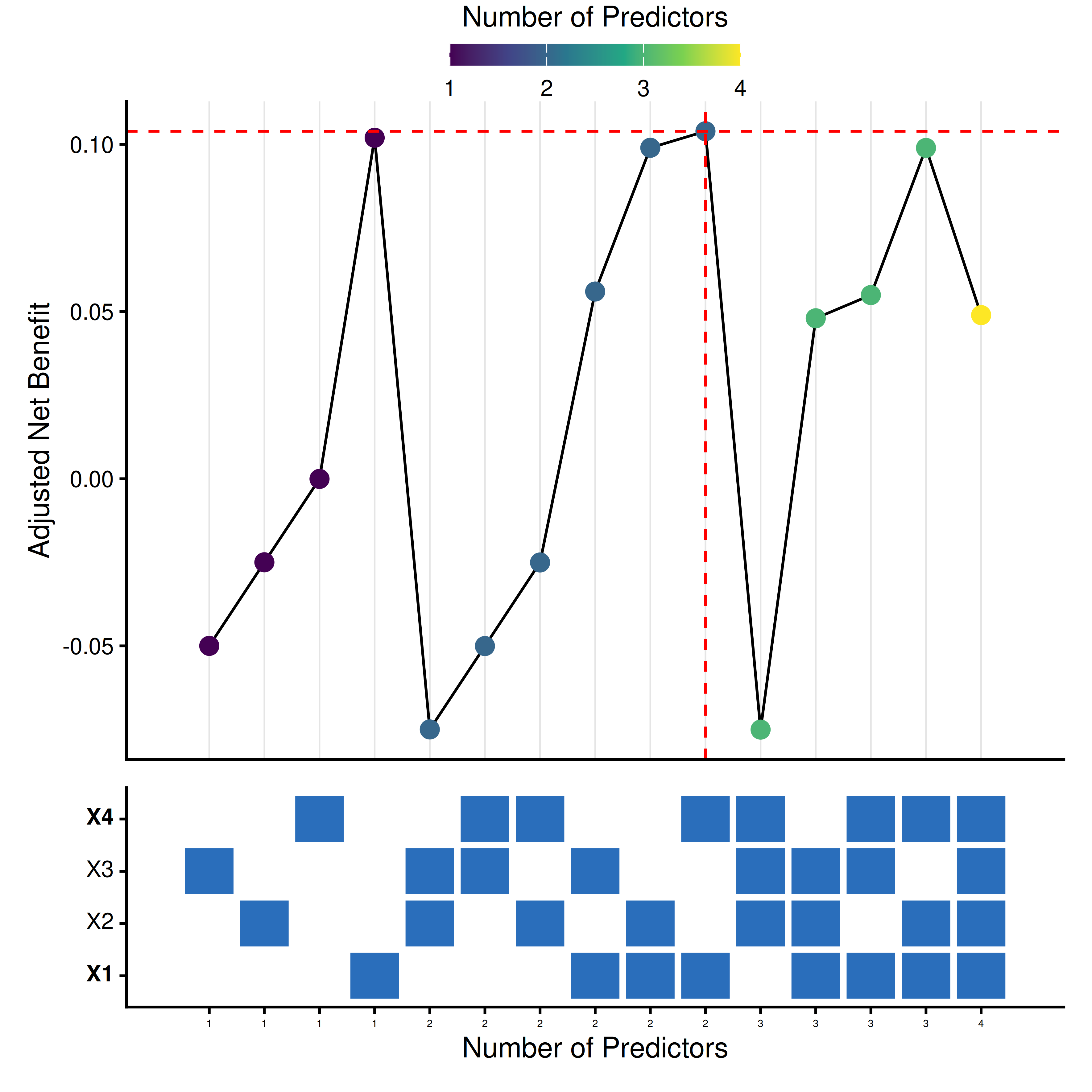
The variable importance of each feature is shown in Figure 1, illustrating the main contributors to utility. In Figure 2, the all-subset plot shows the evolution of the average adjusted Net Benefit across all possible combinations. It is immediately apparent that including X1X_1 improves performance. This simple illustration demonstrates how the best subset of predictors in statistical terms does not necessarily translate to better cost-utility.

Code
VIF_plot(tbl_train)$plot +
  theme(axis.text.x = element_text(angle = 0, hjust = 1))

all_subset_plot(
  tbl_train,
  filter = 100,
  metric = "Avg_Adj_Net_Benefit",
  y_axis = "Adjusted Net Benefit"
)
Figure 1: Net benefit based variable importance for the simple illustration.
Figure 2: All subset plot for the simple illustration.

3 Case study — fabricated clinical data

Reproducible section

This section uses fabricated data designed to resemble a clinical prediction setting. All data generation code is included.

We now demonstrate the methodology on a more realistic scenario. We simulate a dataset mimicking a heart failure readmission prediction setting with 10 predictors and a binary outcome (readmitted within 30 days vs. not). Predictors are grouped into three cost categories:

  • Clinical history (no cost): patient age, prior admission, specialist centre, symptom severity
  • Cardiac imaging (moderate cost): ejection fraction, wall thickness ratio, valve abnormalities, pericardial effusion, chamber dilation
  • Blood biomarker (higher cost): NT-proBNP

3.1 Data generation

Code
# Clean up simple illustration objects to avoid namespace conflicts
rm(list = setdiff(ls(), lsf.str()))

set.seed(8156)
n_train <- 3000
n_test <- 1500
n_total <- n_train + n_test

# Clinical history (free)
patient_age <- round(rnorm(n_total, mean = 68, sd = 12))
prior_admission <- rbinom(n_total, 1, 0.30)
specialist_centre <- rbinom(n_total, 1, 0.45)
symptom_severity <- rbinom(n_total, 1, 0.40)

# Cardiac imaging (moderate cost)
ejection_fraction <- pmin(75, pmax(10, rnorm(n_total, 42, 14)))
wall_thickness <- pmin(1, pmax(0.05, rbeta(n_total, 2, 4)))
valve_abnormalities <- rpois(n_total, lambda = 0.8)
pericardial_effusion <- rbinom(n_total, 1, 0.12)
chamber_dilation <- rbinom(n_total, 1, 0.22)

# Blood biomarker (higher cost)
nt_probnp <- round(pmax(20, rlnorm(n_total, meanlog = 6.5, sdlog = 1.4)))

# True model — strong signal for key predictors
lp <- -16.0 +
  0.07 * patient_age +
  3.0 * prior_admission +
  -0.12 * ejection_fraction +
  10.0 * wall_thickness +
  1.5 * valve_abnormalities +
  2.5 * pericardial_effusion +
  1.8 * chamber_dilation +
  0.9 * log2(nt_probnp) +
  # Weak / null predictors:
  0.03 * specialist_centre +
  0.02 * symptom_severity

readmitted <- rbinom(n_total, 1, plogis(lp))

clinical_df <- data.frame(
  readmitted, patient_age, nt_probnp, prior_admission,
  specialist_centre, ejection_fraction, valve_abnormalities,
  pericardial_effusion, chamber_dilation, symptom_severity,
  wall_thickness
)

training_data <- clinical_df[1:n_train, ]
test_data <- clinical_df[(n_train + 1):n_total, ]

sprintf("Training prevalence: %.1f%%", 100 * mean(training_data$readmitted))
[1] "Training prevalence: 34.5%"
Code
sprintf("Test prevalence: %.1f%%", 100 * mean(test_data$readmitted))
[1] "Test prevalence: 35.8%"

3.2 Cost structure

Costs are defined as grouped costs. The group cost is added once if any predictor from that group is included in the model.

Code
prevalence <- mean(test_data$readmitted)

grouped_costs <- list(
  history = list(
    cost = 0,
    vars = c("patient_age", "prior_admission", "specialist_centre",
             "symptom_severity")
  ),
  imaging = list(
    cost = prevalence * 0.03,
    vars = c(
      "ejection_fraction", "wall_thickness",
      "valve_abnormalities", "pericardial_effusion", "chamber_dilation"
    )
  ),
  biomarker = list(
    cost = prevalence * 0.08,
    vars = c("nt_probnp")
  )
)

3.3 Exhaustive net benefit variable selection

Code
vars <- names(training_data)

start_time <- Sys.time()
exhaustive_results <- nb_varsel(
  data = training_data,
  outcome_var = "readmitted",
  costs = grouped_costs,
  thresholds = seq(0.01, 0.2, by = 0.01),
  include_interactions = FALSE,
  cv_folds = 5,
  mode = "exhaustive",
  allow_parallel = TRUE,
  permutation = TRUE,
  splines = FALSE,
  verbose = FALSE
)
end_time <- Sys.time()

sprintf("Exhaustive search took: %s", format(end_time - start_time))
[1] "Exhaustive search took: 1.763164 mins"

3.3.1 Best model

Code
exhaustive_results$best_model_stats |>
  select(Model, AUC, Brier, Total_Cost, Avg_Adj_Net_Benefit, Avg_Net_Benefit) |>
  gt() |>
  fmt_number(
    columns = c("AUC", "Brier", "Total_Cost", "Avg_Adj_Net_Benefit", "Avg_Net_Benefit"),
    decimals = 3
  ) |>
  cols_label(
    Model = "Included predictors",
    AUC = "AUC",
    Brier = "Brier Score",
    Avg_Net_Benefit = "Avg. Net Benefit",
    Total_Cost = "Total Cost",
    Avg_Adj_Net_Benefit = "Avg. Adj. Net Benefit"
  )
Table 2: Best model from exhaustive search
Included predictors AUC Brier Score Total Cost Avg. Adj. Net Benefit Avg. Net Benefit
patient_age, prior_admission, ejection_fraction, valve_abnormalities, pericardial_effusion, chamber_dilation, wall_thickness 0.896 0.122 0.011 0.285 0.296

3.3.2 All models

Code
all_models <- exhaustive_results$all_models
all_models$Rank_NB <- rank(-all_models$Avg_Net_Benefit, ties.method = "min")
all_models$Rank_adj_NB <- rank(-all_models$Avg_Adj_Net_Benefit, ties.method = "min")

tbl_data <- all_models |>
  select(
    Rank_NB, Rank_adj_NB, Model, AUC, Brier,
    Total_Cost, Avg_Adj_Net_Benefit, Avg_Net_Benefit
  )

tbl <- tbl_data |>
  gt() |>
  fmt_number(
    columns = c("AUC", "Brier", "Total_Cost", "Avg_Adj_Net_Benefit", "Avg_Net_Benefit"),
    decimals = 3
  ) |>
  cols_label(
    Rank_NB = "Rank (NB)",
    Rank_adj_NB = "Rank (Adj. NB)",
    Model = "Included predictors",
    AUC = "AUC",
    Brier = "Brier Score",
    Avg_Net_Benefit = "Avg. NB",
    Total_Cost = "Total Cost",
    Avg_Adj_Net_Benefit = "Avg. Adj. NB"
  )

if (knitr::is_html_output()) {
  tbl <- tbl |>
    opt_interactive(
      use_pagination = TRUE,
      page_size_default = 10,
      use_filters = TRUE,
      use_compact_mode = TRUE
    )
}
tbl
Table 3: All models from exhaustive search

3.3.3 Visualisation

Code
VIF_plot(
  exhaustive_results$all_models,
  filter = round(nrow(exhaustive_results$all_models) * 0.1)
)$plot
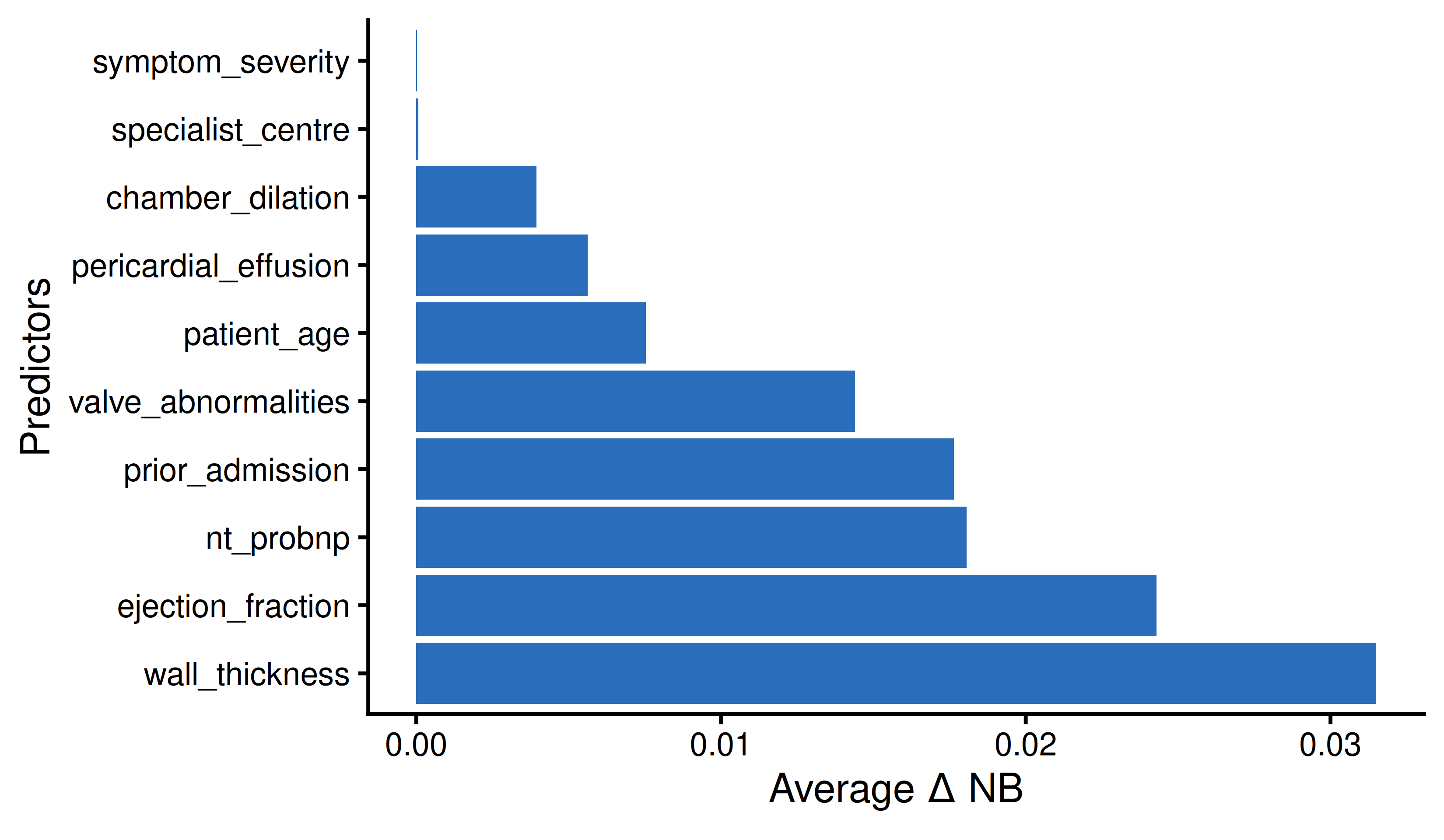
Figure 3: Variable importance plot (exhaustive search)

Figure 3 shows the variable importance based on the average Net Benefit contribution. Predictors are ranked from most to least important.

Code
all_subset_plot(
  exhaustive_results$all_models,
  filter = 7,
  size_dot = 1
)

all_subset_plot(
  exhaustive_results$all_models,
  filter = 7,
  size_dot = 1,
  metric = "Avg_Adj_Net_Benefit",
  y_axis = "Adjusted Net Benefit"
)
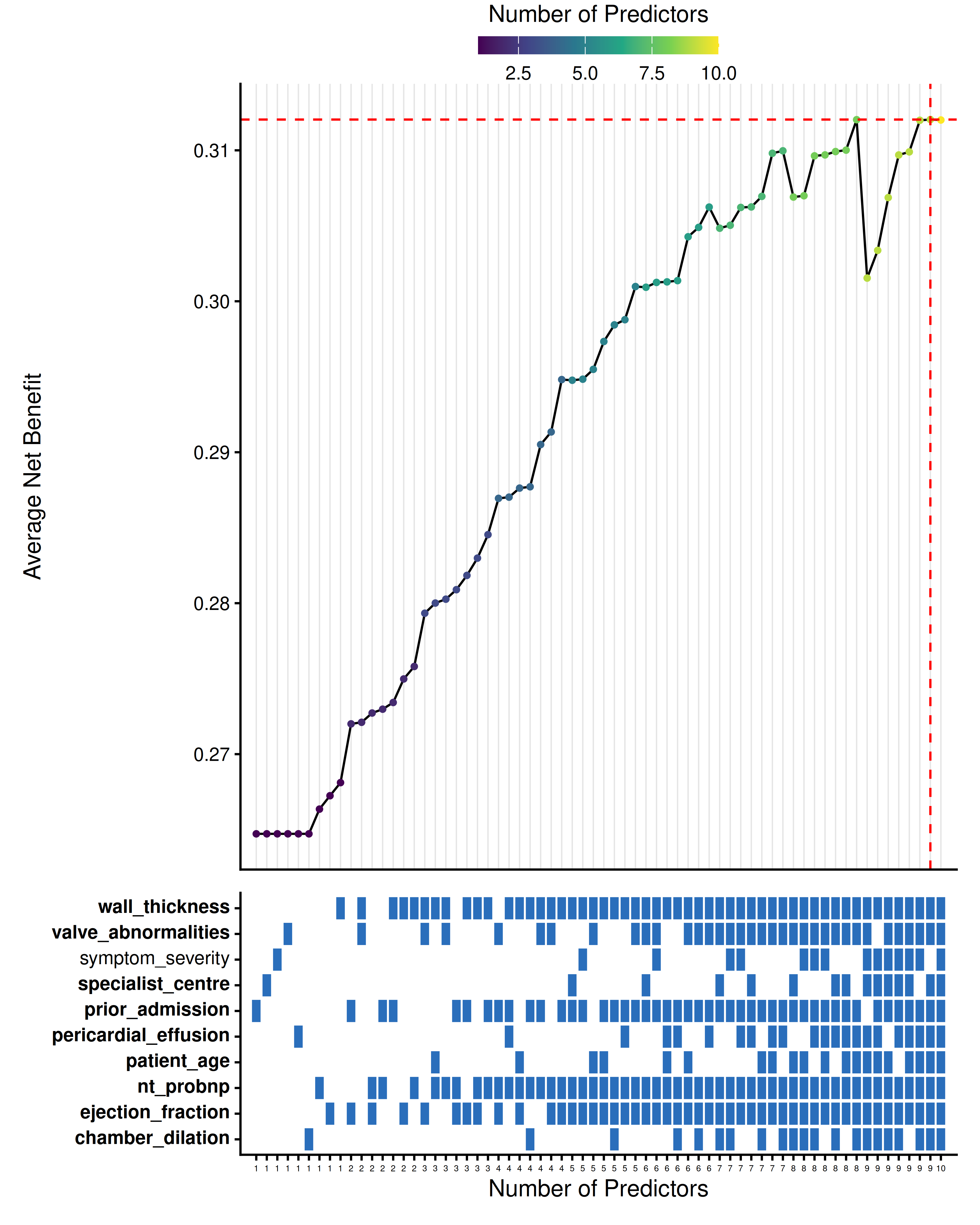
Figure 4: All subset plot (Net Benefit)
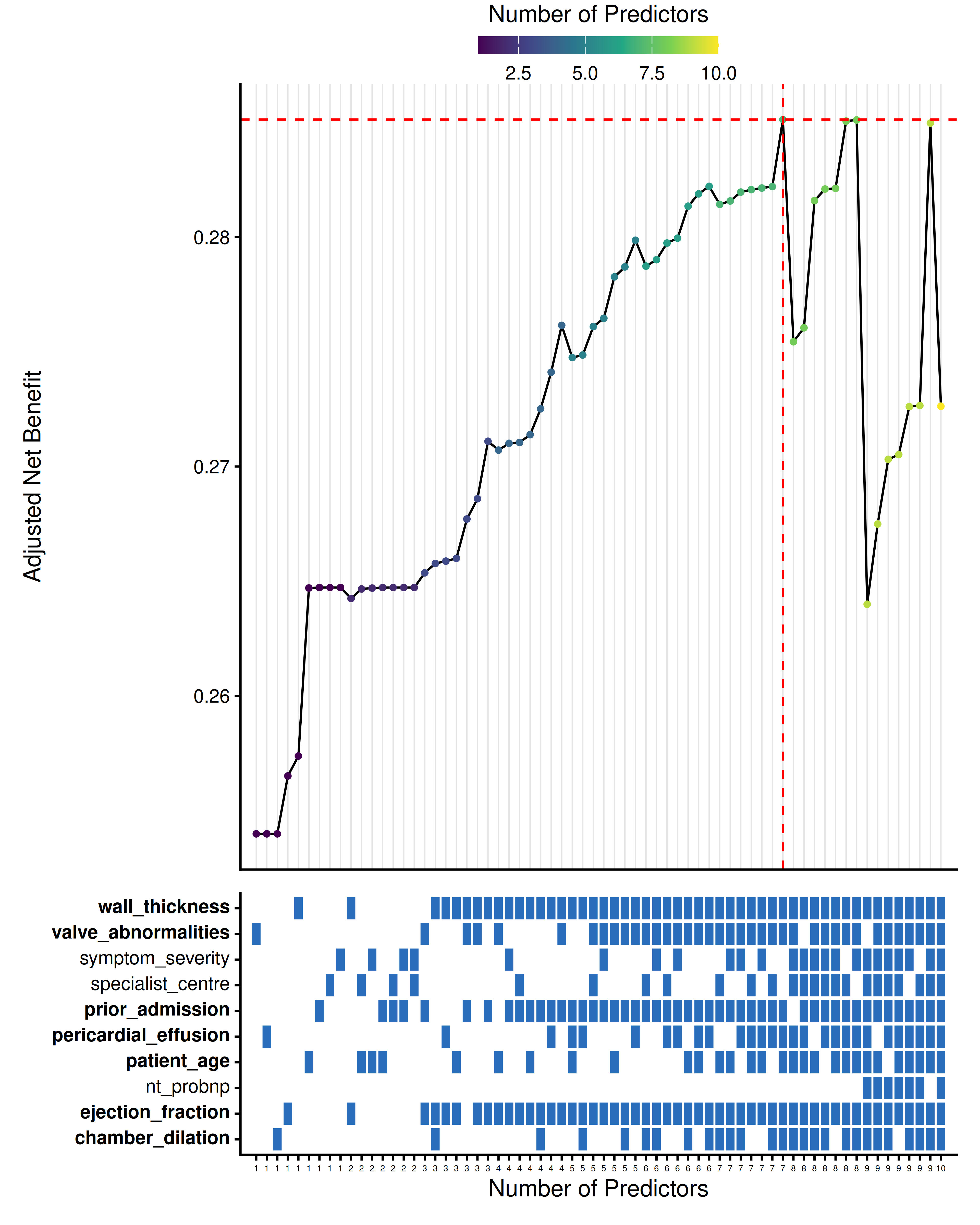
Figure 5: All subset plot (Adjusted Net Benefit)

Figure 4 and Figure 5 show the all-subset plots. Each point represents a model. The heatmap below indicates which predictors are included. Note the difference in ranking when costs are accounted for.

3.4 Groupwise net benefit variable selection

Code
start_time <- Sys.time()
groupwise <- nb_varsel(
  data = training_data,
  outcome_var = "readmitted",
  costs = grouped_costs,
  thresholds = seq(0.01, 0.2, by = 0.01),
  include_interactions = FALSE,
  cv_folds = 5,
  mode = "groupwise",
  allow_parallel = TRUE,
  permutation = TRUE,
  splines = FALSE,
  group_size = 1,
  verbose = TRUE
)
end_time <- Sys.time()
sprintf("Groupwise search took: %s", format(end_time - start_time))
[1] "Groupwise search took: 15.13899 secs"
Code
groupwise$best_model_stats |>
  select(Model, AUC, Brier, Total_Cost, Avg_Adj_Net_Benefit, Avg_Net_Benefit) |>
  gt() |>
  fmt_number(
    columns = c("AUC", "Brier", "Total_Cost", "Avg_Adj_Net_Benefit", "Avg_Net_Benefit"),
    decimals = 3
  ) |>
  cols_label(
    Model = "Included predictors",
    AUC = "AUC",
    Brier = "Brier Score",
    Avg_Net_Benefit = "Avg. NB",
    Total_Cost = "Total Cost",
    Avg_Adj_Net_Benefit = "Avg. Adj. NB"
  )
Table 4: Groupwise selection: best model
Included predictors AUC Brier Score Total Cost Avg. Adj. NB Avg. NB
patient_age, prior_admission, specialist_centre, ejection_fraction, valve_abnormalities, pericardial_effusion, chamber_dilation, wall_thickness 0.895 0.122 0.011 0.285 0.295
Code
VIF_plot(groupwise$all_models)$plot
Figure 6: Variable importance (groupwise selection)

3.5 Comparison with other methods

We compare the NB-based variable selection with backward elimination (Wald statistic) and LASSO (L1-penalised logistic regression).

Code
preds <- setdiff(vars, "readmitted")

# --- Backward elimination ---
fmla_full <- reformulate(termlabels = preds, response = "readmitted")
model_full <- lrm(fmla_full, data = training_data)
bw <- fastbw(model_full)
model_bw <- lrm(
  reformulate(termlabels = bw$names.kept, response = "readmitted"),
  data = training_data
)
test_data$bw_pred <- plogis(predict(model_bw, newdata = test_data))

# --- LASSO ---
x_train <- as.matrix(training_data[, preds])
y_train <- training_data$readmitted
x_test <- as.matrix(test_data[, preds])

set.seed(4738)
cv_lasso <- cv.glmnet(x_train, y_train, alpha = 1, family = "binomial")
lasso_coefs <- coef(cv_lasso, s = "lambda.1se")
lasso_kept <- rownames(lasso_coefs)[as.vector(lasso_coefs != 0)]
lasso_kept <- setdiff(lasso_kept, "(Intercept)")
test_data$lasso_pred <- as.vector(
  plogis(predict(cv_lasso, newx = x_test, s = "lambda.1se"))
)

# --- NB models ---
preds_best_nb <- str_trim(
  str_split(
    all_models |> arrange(-Avg_Net_Benefit) |> slice(1) |> pull(Model),
    ","
  )[[1]]
)
preds_best_adj <- str_trim(
  str_split(exhaustive_results$best_model_stats$Model, ",")[[1]]
)

model_nb <- lrm(
  reformulate(preds_best_nb, "readmitted"),
  data = training_data
)
model_adj_nb <- lrm(
  reformulate(preds_best_adj, "readmitted"),
  data = training_data
)
test_data$nb_pred <- plogis(predict(model_nb, newdata = test_data))
test_data$adj_nb_pred <- plogis(predict(model_adj_nb, newdata = test_data))

3.5.1 Selected variables

Code
sprintf("NB model retains: %s", paste(preds_best_nb, collapse = ", "))
[1] "NB model retains: patient_age, nt_probnp, prior_admission, specialist_centre, ejection_fraction, valve_abnormalities, pericardial_effusion, chamber_dilation, wall_thickness"
Code
sprintf("Adjusted NB model retains: %s", paste(preds_best_adj, collapse = ", "))
[1] "Adjusted NB model retains: patient_age, prior_admission, ejection_fraction, valve_abnormalities, pericardial_effusion, chamber_dilation, wall_thickness"
Code
sprintf("Backward elimination retains: %s", paste(bw$names.kept, collapse = ", "))
[1] "Backward elimination retains: patient_age, nt_probnp, prior_admission, ejection_fraction, valve_abnormalities, pericardial_effusion, chamber_dilation, wall_thickness"
Code
sprintf("LASSO retains: %s", paste(lasso_kept, collapse = ", "))
[1] "LASSO retains: patient_age, nt_probnp, prior_admission, ejection_fraction, valve_abnormalities, pericardial_effusion, chamber_dilation, symptom_severity, wall_thickness"

3.5.2 Discrimination

Code
auc_results <- data.frame(
  Method = c("NB Model", "Adjusted NB Model", "Backward elimination", "LASSO"),
  AUC = c(
    as.numeric(pROC::auc(test_data$readmitted, test_data$nb_pred)),
    as.numeric(pROC::auc(test_data$readmitted, test_data$adj_nb_pred)),
    as.numeric(pROC::auc(test_data$readmitted, test_data$bw_pred)),
    as.numeric(pROC::auc(test_data$readmitted, test_data$lasso_pred))
  ),
  n_predictors = c(
    length(preds_best_nb),
    length(preds_best_adj),
    length(bw$names.kept),
    length(lasso_kept)
  )
)

auc_results |>
  gt() |>
  fmt_number(columns = "AUC", decimals = 3) |>
  cols_label(n_predictors = "N predictors")
Table 5: AUC on test data for each variable selection method
Method AUC N predictors
NB Model 0.926 9
Adjusted NB Model 0.890 7
Backward elimination 0.927 8
LASSO 0.926 9

3.5.3 Decision curve analysis

Code
thresholds <- seq(0.01, 0.30, by = 0.005)
n_test_obs <- nrow(test_data)
y_test <- test_data$readmitted
prev <- mean(y_test)

calc_nb <- function(probs, y, thresholds) {
  n <- length(y)
  vapply(thresholds, function(pt) {
    pred_pos <- probs >= pt
    tp <- sum(y == 1 & pred_pos)
    fp <- sum(y == 0 & pred_pos)
    (tp / n) - (fp / n) * (pt / (1 - pt))
  }, numeric(1))
}

nb_all <- prev - (1 - prev) * (thresholds / (1 - thresholds))

dca_df <- bind_rows(
  data.frame(
    threshold = thresholds,
    net_benefit = calc_nb(test_data$nb_pred, y_test, thresholds),
    label = "NB Model"
  ),
  data.frame(
    threshold = thresholds,
    net_benefit = calc_nb(test_data$adj_nb_pred, y_test, thresholds),
    label = "Adjusted NB Model"
  ),
  data.frame(
    threshold = thresholds,
    net_benefit = calc_nb(test_data$bw_pred, y_test, thresholds),
    label = "Backward elimination"
  ),
  data.frame(
    threshold = thresholds,
    net_benefit = calc_nb(test_data$lasso_pred, y_test, thresholds),
    label = "LASSO"
  ),
  data.frame(
    threshold = thresholds,
    net_benefit = nb_all,
    label = "Treat all"
  ),
  data.frame(
    threshold = thresholds,
    net_benefit = 0,
    label = "Treat none"
  )
)

# Compute costs per method
cost_nb <- NBvarsel:::calculate_model_cost(preds_best_nb, grouped_costs)
cost_adj <- NBvarsel:::calculate_model_cost(preds_best_adj, grouped_costs)
cost_bw <- NBvarsel:::calculate_model_cost(bw$names.kept, grouped_costs)
cost_lasso <- NBvarsel:::calculate_model_cost(lasso_kept, grouped_costs)

dca_df <- dca_df |>
  mutate(
    cost = case_when(
      label == "NB Model" ~ cost_nb,
      label == "Adjusted NB Model" ~ cost_adj,
      label == "Backward elimination" ~ cost_bw,
      label == "LASSO" ~ cost_lasso,
      TRUE ~ 0
    ),
    adj_net_benefit = net_benefit - cost
  )

model_labels <- c(
  "NB Model", "Adjusted NB Model", "Backward elimination",
  "LASSO", "Treat all", "Treat none"
)
dca_df$label <- factor(dca_df$label, levels = model_labels)

# Raw NB
ggplot(dca_df, aes(x = threshold, y = net_benefit, color = label, linetype = label)) +
  geom_line(linewidth = 0.7) +
  theme_classic(base_size = 12) +
  labs(x = "Decision Threshold", y = "Net Benefit", color = "Strategy",
       linetype = "Strategy") +
  coord_cartesian(xlim = c(0, 0.30), ylim = c(-0.01, max(dca_df$net_benefit) * 1.05)) +
  scale_color_manual(values = c(
    "NB Model" = "#0072B5", "Adjusted NB Model" = "#BC3C29",
    "Backward elimination" = "#E18727", "LASSO" = "#20854E",
    "Treat all" = "black", "Treat none" = "black"
  )) +
  scale_linetype_manual(values = c(
    "NB Model" = "solid", "Adjusted NB Model" = "solid",
    "Backward elimination" = "solid", "LASSO" = "solid",
    "Treat all" = "dashed", "Treat none" = "dotted"
  ))
# Adjusted NB
ggplot(dca_df, aes(x = threshold, y = adj_net_benefit, color = label, linetype = label)) +
  geom_line(linewidth = 0.7) +
  theme_classic(base_size = 12) +
  labs(
    x = "Decision Threshold",
    y = "Harm-adjusted Net Benefit",
    color = "Strategy",
    linetype = "Strategy"
  ) +
  coord_cartesian(xlim = c(0, 0.30), ylim = c(-0.01, max(dca_df$adj_net_benefit) * 1.05)) +
  scale_color_manual(values = c(
    "NB Model" = "#0072B5", "Adjusted NB Model" = "#BC3C29",
    "Backward elimination" = "#E18727", "LASSO" = "#20854E",
    "Treat all" = "black", "Treat none" = "black"
  )) +
  scale_linetype_manual(values = c(
    "NB Model" = "solid", "Adjusted NB Model" = "solid",
    "Backward elimination" = "solid", "LASSO" = "solid",
    "Treat all" = "dashed", "Treat none" = "dotted"
  ))
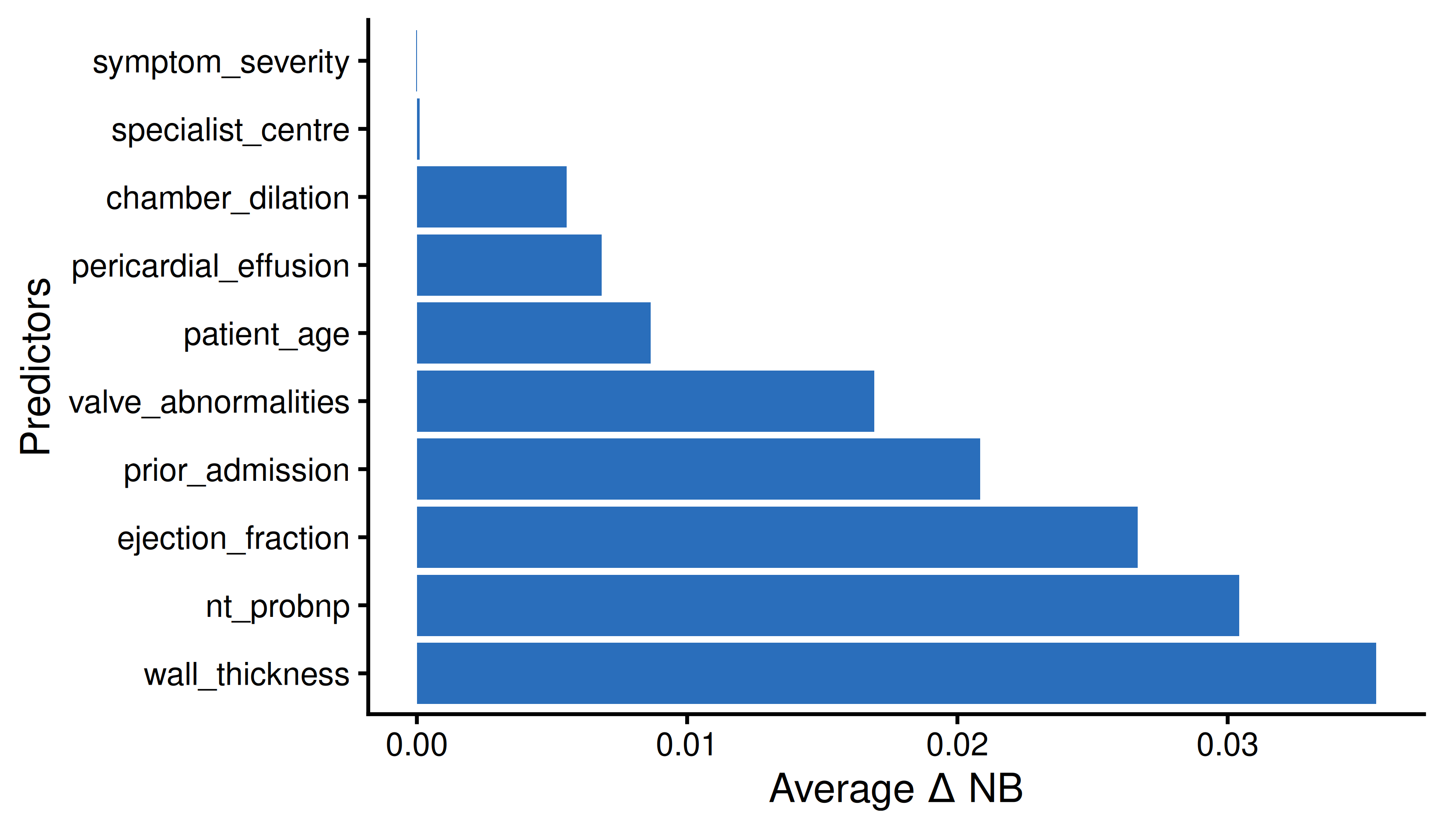
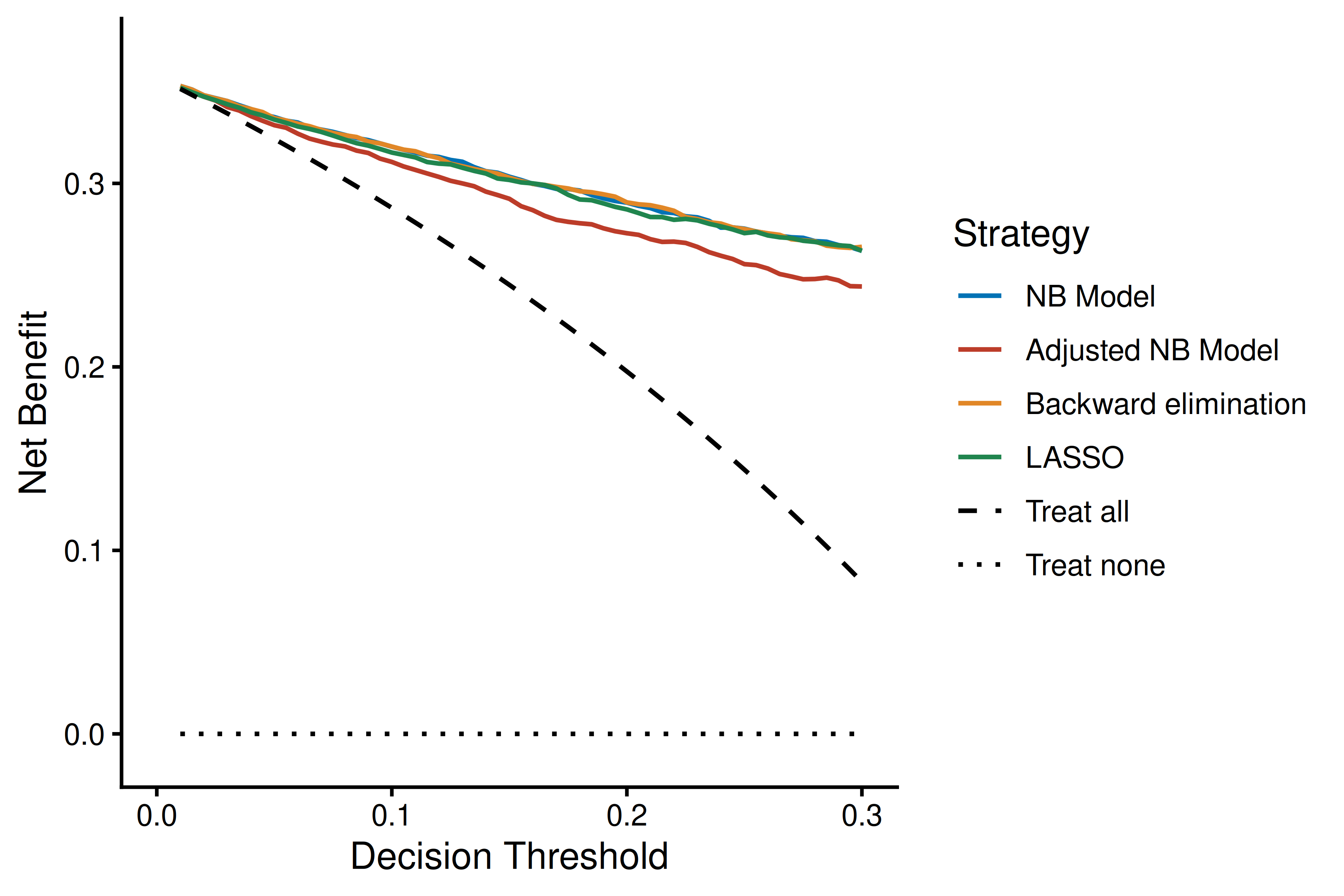
Figure 7: Decision curve analysis comparing net benefit across methods.
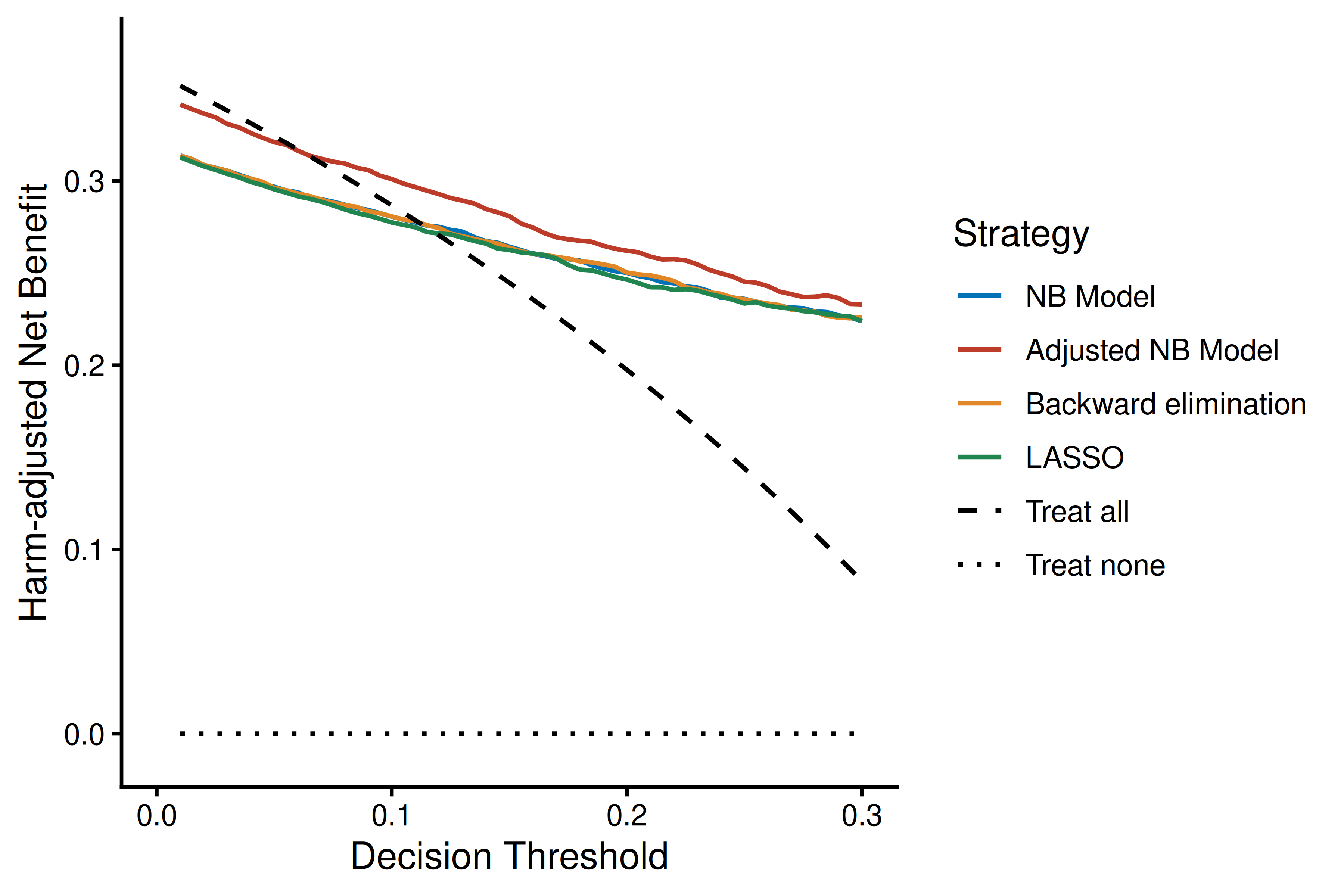
Figure 8: Decision curve analysis comparing harm-adjusted net benefit.

Figure 7 shows the standard decision curve analysis. Figure 8 shows the same curves after subtracting each method’s test costs, highlighting the advantage of cost-aware variable selection.

4 Case study — ADNEX ovarian tumour data

Pre-computed results

The original patient-level data from the IOTA consortium are not publicly available. This section uses pre-computed results shipped with the package (adnex_results). The analysis code is shown for transparency but is not executed.

This section demonstrates the methodology on real clinical data used to develop the ADNEX model for classifying ovarian tumours as benign or malignant. The data come from the International Ovarian Tumour Analysis (IOTA) consortium, phases 1–3, and comprise 16 candidate predictors.

4.1 Predictors and cost structure

Predictors are grouped into three cost categories reflecting the clinical workflow:

  • Clinical history (no cost): patient age, family history of ovarian cancer, oncology centre, pain
  • Ultrasound examination (moderate cost): maximum lesion diameter, proportion solid, locules > 10, papillary count, papillary presence, acoustic shadows, ascites, irregular walls, bilateral, colour score, maximum solid diameter
  • Blood biomarker (higher cost): CA-125
Code
vars <- c(
  "malignant", "age", "ca125", "family_history", "locules_gt_10",
  "oncology_center", "max_diam_lesion", "papillary_count",
  "acoustic_shadows", "ascites", "ireg_walls", "bilateral",
  "color_score", "pain", "max_diam_solid", "papillary_presence",
  "prop_solid"
)

prevalence <- mean(test_data$malignant)

grouped_costs <- list(
  history = list(
    cost = 0,
    vars = c("age", "family_history", "oncology_center", "pain")
  ),
  US = list(
    cost = prevalence * 0.02,
    vars = c(
      "max_diam_lesion", "prop_solid", "locules_gt_10",
      "papillary_count", "acoustic_shadows", "ascites",
      "bilateral", "ireg_walls", "papillary_presence",
      "color_score", "max_diam_solid"
    )
  ),
  blood = list(
    cost = prevalence * 0.05,
    vars = c("ca125")
  )
)

The exhaustive search evaluated all 65,535 (2^16 - 1) predictor combinations using 20-fold cross-validation with restricted cubic splines (3 knots) and permutation importance.

Code
exhaustive_results <- nb_varsel(
  data = training_data[, vars],
  outcome_var = "malignant",
  costs = grouped_costs,
  thresholds = seq(0.01, 0.2, by = 0.01),
  include_interactions = FALSE,
  cv_folds = 20,
  mode = "exhaustive",
  allow_parallel = TRUE,
  permutation = TRUE,
  splines = TRUE
)

The pre-computed results are available as a shipped dataset:

Code
data(adnex_results)

4.2.1 Best model

Code
best <- attr(adnex_results, "best_model_stats")

best |>
  select(Model, n_Preds, AUC, Brier, Total_Cost,
         Avg_Adj_Net_Benefit, Avg_Net_Benefit) |>
  gt() |>
  fmt_number(
    columns = c("AUC", "Brier", "Total_Cost",
                "Avg_Adj_Net_Benefit", "Avg_Net_Benefit"),
    decimals = 3
  ) |>
  cols_label(
    Model = "Included predictors",
    n_Preds = "N",
    AUC = "AUC",
    Brier = "Brier Score",
    Avg_Net_Benefit = "Avg. NB",
    Total_Cost = "Total Cost",
    Avg_Adj_Net_Benefit = "Avg. Adj. NB"
  )
Table 6: Best model from the ADNEX exhaustive search (ranked by cost-adjusted Net Benefit)
Included predictors N AUC Brier Score Total Cost Avg. Adj. NB Avg. NB
age, locules_gt_10, oncology_center, max_diam_lesion, papillary_count, acoustic_shadows, ascites, ireg_walls, bilateral, color_score, pain, papillary_presence, prop_solid 13 0.952 0.080 0.005 0.290 0.295

The best model retains 13 of the 16 predictors, excluding CA-125, family history, and maximum solid diameter. Despite using fewer predictors, the cost-adjusted Net Benefit is maximised because the excluded predictors contributed little utility relative to their cost.

4.2.2 Top models

Code
adnex_results$Rank_adj_NB <- rank(
  -adnex_results$Avg_Adj_Net_Benefit, ties.method = "min"
)

tbl_data <- adnex_results |>
  select(Rank_adj_NB, Model, n_Preds, AUC, Brier,
         Total_Cost, Avg_Adj_Net_Benefit, Avg_Net_Benefit)

tbl <- tbl_data |>
  gt() |>
  fmt_number(
    columns = c("AUC", "Brier", "Total_Cost",
                "Avg_Adj_Net_Benefit", "Avg_Net_Benefit"),
    decimals = 3
  ) |>
  cols_label(
    Rank_adj_NB = "Rank (Adj. NB)",
    Model = "Included predictors",
    n_Preds = "N",
    AUC = "AUC",
    Brier = "Brier Score",
    Avg_Net_Benefit = "Avg. NB",
    Total_Cost = "Total Cost",
    Avg_Adj_Net_Benefit = "Avg. Adj. NB"
  )

if (knitr::is_html_output()) {
  tbl <- tbl |>
    opt_interactive(
      use_pagination = TRUE,
      page_size_default = 10,
      use_filters = TRUE,
      use_compact_mode = TRUE
    )
}
tbl
Table 7: Top models per predictor count from the ADNEX exhaustive search

4.2.3 Visualisation

Code
VIF_plot(adnex_results)$plot
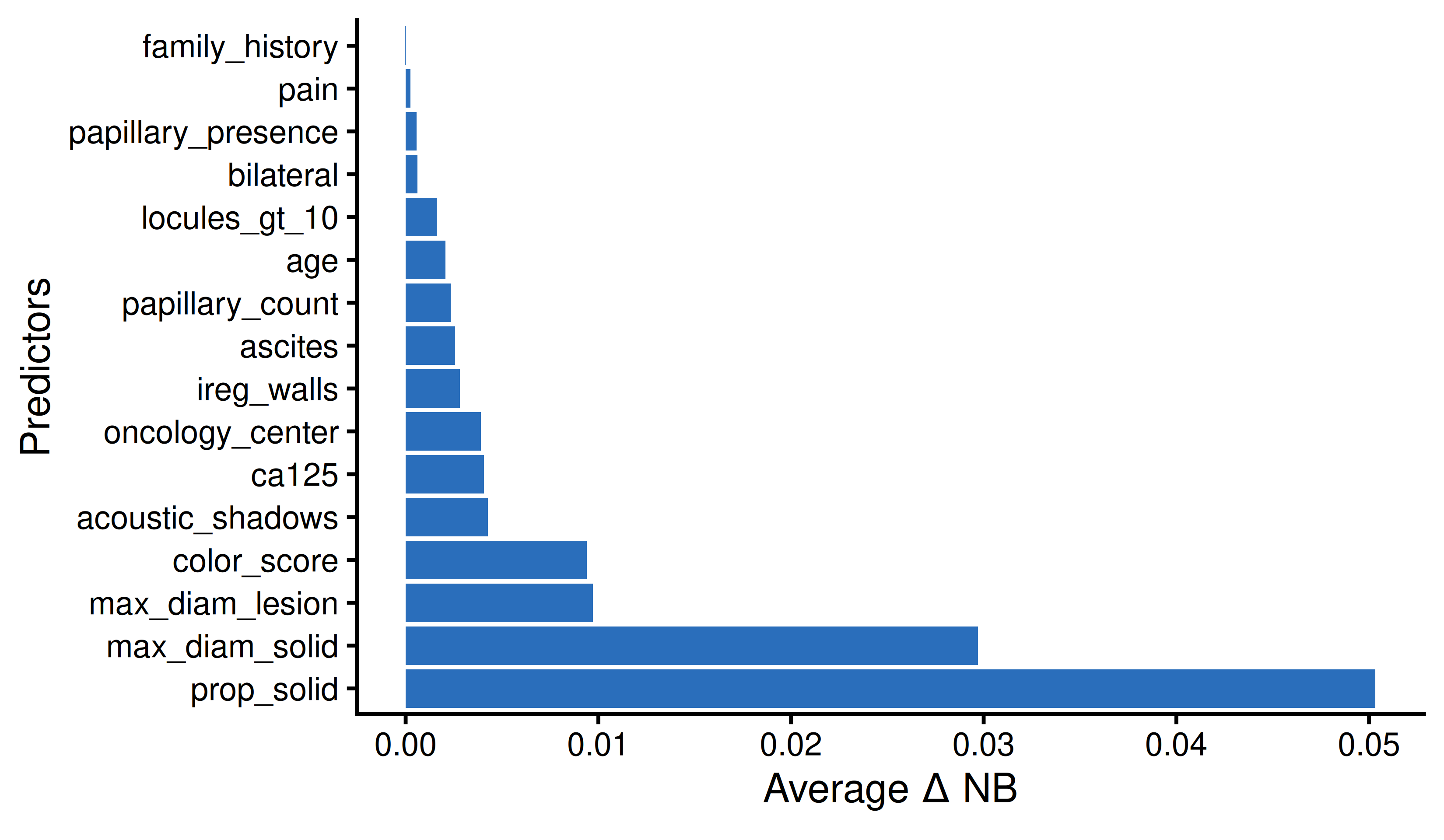
Figure 9: Variable importance for the ADNEX case study. Bars show the average drop in Net Benefit when each predictor is permuted.

Figure 9 shows that the proportion solid component and colour score are the most important predictors for clinical utility, followed by maximum lesion diameter and oncology centre status.

Code
all_subset_plot(
  adnex_results,
  filter = 7,
  size_dot = 1
)

all_subset_plot(
  adnex_results,
  filter = 7,
  size_dot = 1,
  metric = "Avg_Adj_Net_Benefit",
  y_axis = "Adjusted Net Benefit"
)
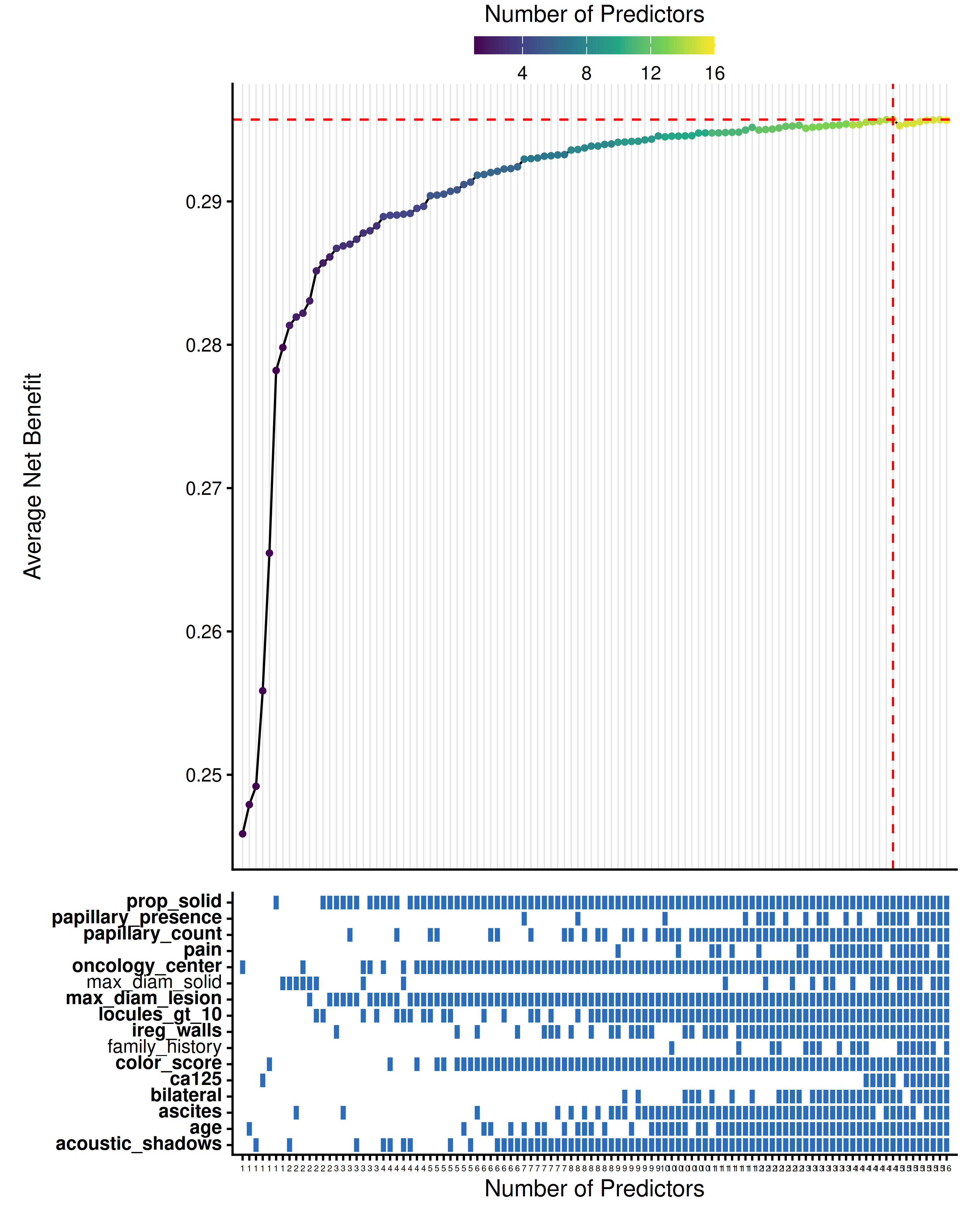
Figure 10: All subset plot (Net Benefit) for the ADNEX case study.
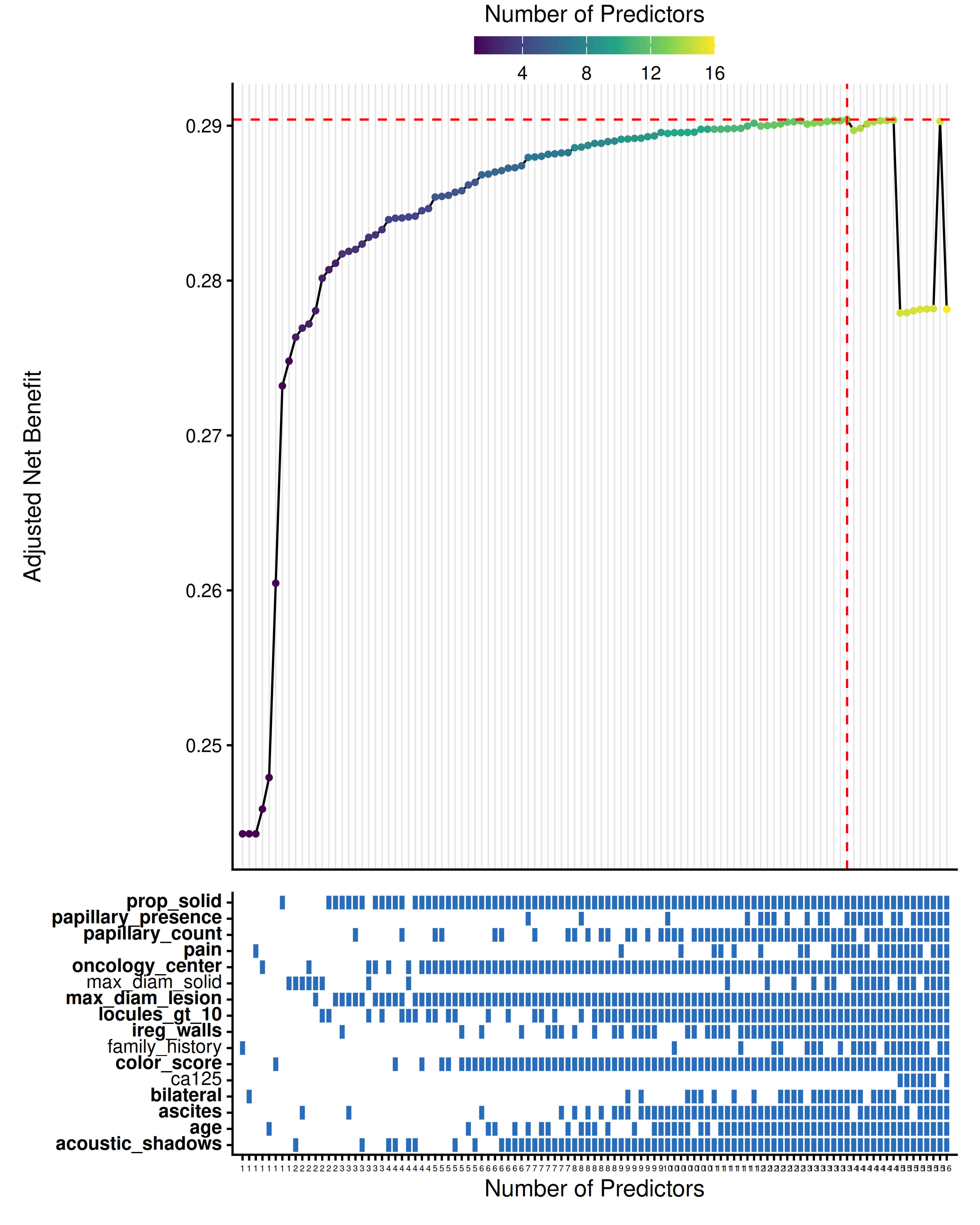
Figure 11: All subset plot (cost-adjusted Net Benefit) for the ADNEX case study.

Figure 10 and Figure 11 show the all-subset plots. The heatmap indicates which predictors are included in each model. The best model’s predictors are highlighted in bold. Note that cost adjustment changes the ranking: models that include the blood biomarker (CA-125) are penalised, shifting the optimum toward models relying on ultrasound and clinical history alone.

5 Summary

This vignette demonstrated the NBvarsel workflow:

  1. nb_varsel() identifies optimal predictor subsets by maximising cross-validated Net Benefit, optionally adjusted for test costs.
  2. VIF_plot() visualises permutation-based variable importance.
  3. all_subset_plot() provides a comprehensive view of model performance and predictor inclusion across all evaluated combinations.
  4. External validation of selected models can be performed using standard discrimination metrics such as AUC.

The key insight is that the statistically best-performing model may not be the most clinically useful when predictor costs are taken into account. Cost-aware variable selection via Net Benefit can lead to simpler, cheaper models that maintain or improve clinical utility.